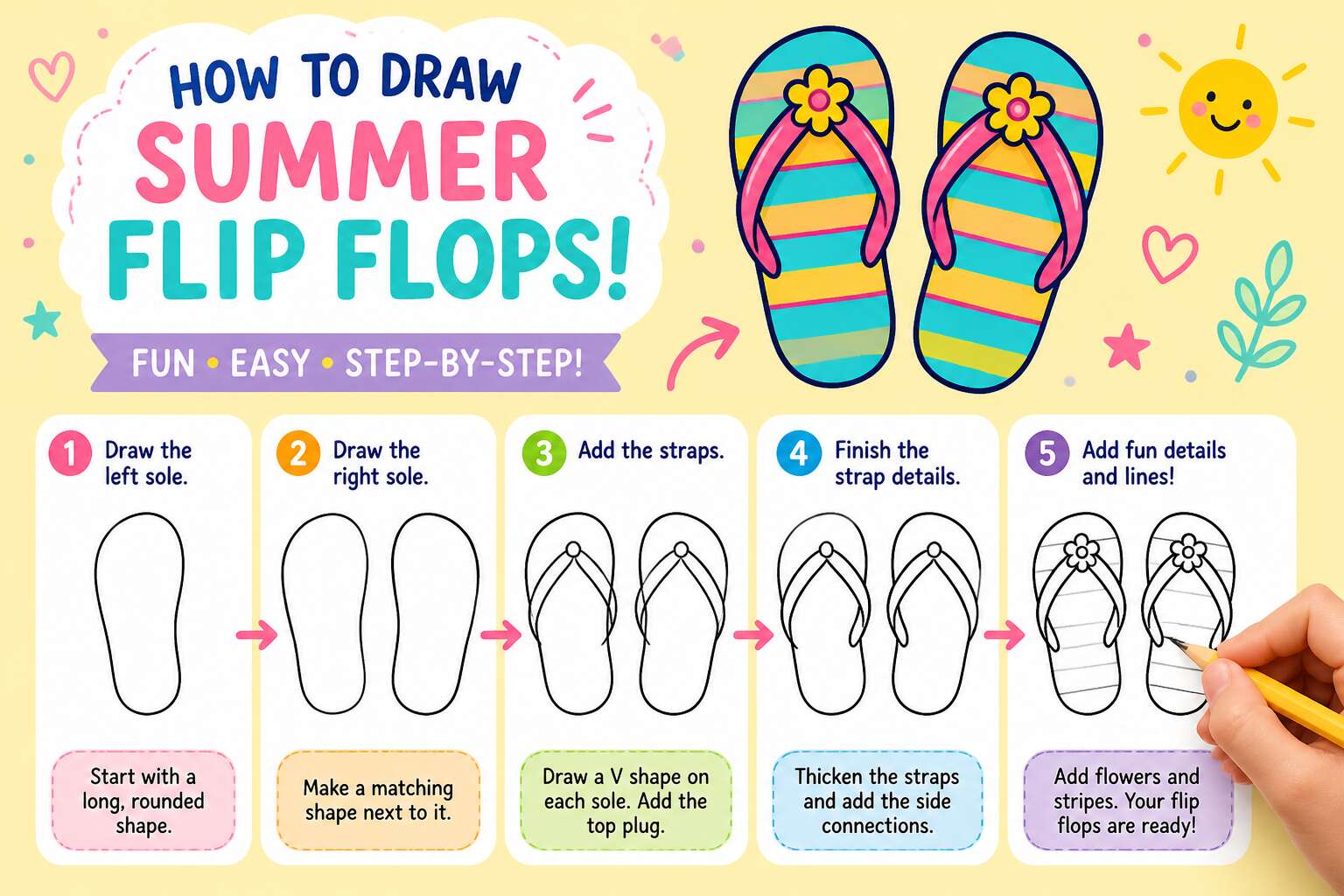
Getting Started with Simple Flip Flop Sketches
The flip flop is a constant presence in South African life. This simple sandal appears on pavements, beaches and stoeps. To begin, hold your pencil lightly and follow the sole’s curve. This is where flip flops easy drawing starts, not with details, but with the calm outline of the shape itself. Give yourself permission to draw slowly.
Look at what you see:
- The broad band of the strap across the foot
- The small dent where the toe sits
- The way the light falls on the rubber
These elements guide your hand. Flip flops easy drawing becomes less about accuracy and more about finding the rhythm in the lines. I often start with the strap first, then the sole. It keeps the drawing grounded. On a hot day, this practice feels almost meditative. You can capture it in a few strokes.
Breaking Down the Flip Flop into Basic Shapes
Roughly 1.2 billion pairs of flip flops are sold annually, and South Africans certainly carry their share. That figure still amazes me! Yet most drawing attempts collapse because people insist on drawing the shoe. The slop is a geometry problem, not a footwear problem.
Your own slops show this clearly. There is a long ellipse for the sole and two curved bands meeting for the thong and the strap. The worn toe groove, the faded logo, the cracked foam; they are all distractions.
The shapes are simple to isolate:
- An elongated ellipse forms the sole.
- Two curves converge at the centre for the thong.
- A shallow arc finishes the toe strap.
Those three forms are what matter. For flip flops easy drawing, this breakdown is everything.
Step-by-Step Process for a Cute Cartoon Flip Flop
Drawing a flip flop sounds deceptively simple until you try to capture its lazy charm. The secret lies in the thong’s curve and the sole’s gentle tilt. I start by mapping the basic shape, then let the lines loosen. Here is my sequence.
- Sketch a rounded rectangle, slightly tapered at the heel.
- Erase the top edge to create the foot bed.
- Add the toe post as a small cylinder.
- Draw the straps with soft, confident strokes.
That carelessness is what makes flip flops easy drawing. Each stroke should feel relaxed, almost careless. I shade lightly under the sole to ground the flip flop, then thicken the outline for a cartoon pop. The toe post needs a tiny shadow. Step back, and you have a flip flop ready to shuffle across a warm sidewalk. Flip flops easy drawing rewards patience over pressure.
Exploring Creative Flip Flop Variations
In South Africa, nearly nine out of ten beachgoers own flip flops, yet almost none ever attempt to draw them. That omission feels like a quiet tragedy, because the humble sole carries the memory of every warm sand dune and dusty pavement.
Creative variations begin with the straps. Straight lines, curved arcs, or twisted ropes change the entire silhouette. For flip flops easy drawing, I focus on negative space between the toes. The arch is where character lives.
- Thick rubber soles with deep treads
- Thin leather straps that cross over the arch
- Beaded decorations that catch the light
Each version demands a different hand pressure. A heavier touch for chunky soles, a feathery stroke for delicate straps. The tragedy is that most sketches flatten these differences into the same boring outline.
Polishing Your Drawing with Shading and Details
Shading is where a flip flops easy drawing stops being a line sketch and starts feeling like a worn object. Press harder along the sole’s edge, then soften toward the toe. That tonal shift mimics years of pressure and sun exposure.
- Use a blunt pencil for the deep shadows where the straps meet the footbed.
- Layer light horizontal strokes across the foam to capture scuffed texture.
- Leave a bright area under the big toe to suggest natural fading.
The details don’t need to be abundant. One confident shadow on the heel can carry more weight than a dozen thin outlines. Restraint is the real skill here. When you stop overworking the rubber, the drawing starts to breathe on its own.



0 Comments