Essential Features to Look for in Children’s Beach Sandals
Arch Support for Growing Feet
The child’s foot, a lattice of unformed bone and stubborn cartilage, deserves more than a flat slab of rubber. Most beach sandals ignore the natural arch entirely, leaving young feet to collapse inward during a day of relentless shore play. Arch support in children’s footwear is not a luxury. It is a quiet safeguard for developing alignment.
Look for a contoured footbed that rises gently at the inner edge. A deep heel cup is equally vital. It cradles the calcaneus, preventing the ankle from rolling as the child runs over wet sand or slippery rocks. The material should be firm enough to resist twisting, yet forgiving underfoot. Avoid offering only a vague bump.
- A rigid but flexible shank to maintain structure
- A raised toe bar to engage the gripping muscles
- Non-slip outsoles with a subtle tread for uneven ground
For flip flops for kids, these features transform a simple item from a casual throwaway into a functional tool. I have seen too many pairs that sacrifice form for a flashy print. Choose the hidden engineering over the loud colour. Their feet will remember the difference.
Durable Materials for Active Play
The average child’s sandal survives 74 days of active wear. A single beach trip can end that run early. Flip flops for kids endure the harshest summer conditions. South African shores punish them with salt water, sun-bleached sand, and jagged rocks.
Durable materials for active play begin with the outsole. Vulcanised rubber or dense EVA resists tearing, while soft foam compresses under constant weight. Reinforced webbing and moulded synthetic straps survive repeated wetting and drying. I have watched thin PVC crack under the Cape sun. A well-built pair of flip flops for kids handles a full season of tidal pools without losing shape.
- Double-stitched or heat-welded strap attachments
- Closed-cell foam that repels water and resists odour
- UV-stabilised materials to prevent fading and brittleness
The flex point at the ball of the foot reveals intent. A sandal bending too easily offers no protection; one barely bending fights the child’s natural stride.
Non-Slip Soles for Wet Surfaces
A wet pool deck is a social equaliser. It humbles adults and children alike, though children recover faster from the indignity. The outsole of flip flops for kids should carry a tread pattern designed for the wettest conditions. Shallow siping channels water away from the footbed. Rubber compounds with a high coefficient of friction grip wet sandstone and paving. Some soles use a honeycomb pattern to bite into algae covered surfaces.
Test the sole yourself. Press it against a damp paving stone and slide. If it skates, it will fail at the first tidal pool visit. The best flip flops for kids use a multidirectional lug pattern. This delivers traction when running forward, stopping short, or turning on a slippery ramp.
- Look for treads with at least 2 mm depth
- Choose natural rubber over synthetic blends for wet grip
- Check that the tread wraps slightly up the heel
A sole that grips only when dry is a liability. The beach rewards careful footwear choices.
Adjustable Straps for a Secure Fit
A child’s foot changes size throughout the day, swelling in the heat and shrinking when the tide rolls in. For flip flops for kids, a fixed strap becomes a gamble. An adjustable system, whether a simple Velcro tab or a multi-hole buckle, lets you dial in the fit precisely as conditions shift.
Consider how sand and water alter the foot’s grip inside the sandal. A loose strap leads to friction, blisters, and a lost thong. A tight one cuts off circulation. The best designs offer micro-adjustments at the heel and across the instep.
- Hook-and-loop closures that survive repeated soaking
- Buckles with at least three position points
- A rear heel loop that keeps the foot from sliding out
Testing the adjustment while wet is essential. The strap should hold firm without digging in, and the child should be able to wiggle their toes. That balance creates a secure fit that lasts the entire beach day.
Breathable Fabrics That Prevent Sweating
Here is a truth parents learn quickly: a child’s foot in summer perspires with the enthusiasm of a marathon runner. When a sandal traps that moisture, the result is a damp, grimy foot and a shoe that smells like regret. Breathable fabrics solve this. The best flip flops for kids use open cell foams, mesh panels, or quick drying synthetics that allow air to move freely.
Sweat itself is harmless. Trapped sweat is what causes blisters and that distinctive odour. A breathable footbed pulls moisture away from the skin, keeping things dry even after a long paddle in the surf.
Consider these features:
– Perforated outsoles that drain water instantly
– Mesh linings that dry within minutes
– Natural fibre straps that resist odour buildup
A sandal that breathes well keeps the foot comfortable and the car ride home bearable.
Age-by-Age Guide to Kids’ Summer Footwear
Toddlers 1 to 3: Flexibility and First Steps
Toddlers between one and three are learning to balance on their own two feet. Their bones are soft and their strides are unsteady. Summer footwear for this stage should bend easily, because rigid soles disrupt a natural gait. Flip flops for kids rarely offer that controlled flexibility, so parents often choose soft, closed-toe sandals with a flexible footbed instead.
A simple test: hold the shoe and bend it. The toe should curl toward the instep without resistance. If it fights you, leave it on the shelf. At this age, children feel the ground through their feet, which helps them learn where to place each foot.
- Flat soles that move with the foot are your friend.
- Avoid thick, cushioned platforms that mute the ground.
Preschoolers 3 to 5: Easy-On Designs for Self-Dressing
Getting out the door can be a struggle. A three year old insists on independence, but her fingers still fumble. So the shoe must cooperate with her urgency. Hook-and-loop straps that peel wide open, elastic gussets that stretch, and openings wide enough to catch her foot on the first attempt. These details matter more than any fashion statement.
A child this age has a will, but not the dexterity for laces or buckles. She will bend over, wrestle, and eventually lose patience. The best designs let her succeed quickly. Look for:
- Straps that release fully to open the shoe wide
- Heel loops that give small fingers something to pull
- Soft, flexible materials that don’t require force to slip on
This is why flip flops for kids often fail here. They require a gripping action between the toes and a precise step. Preschoolers lack both. They slip, they flip, they frustrate.
School-Age Kids 5 to 8: All-Day Comfort for Playground Adventures
By the age of five, footfall gains momentum. The playground becomes a zone of leaps, slides, and sudden stops. For children aged five to eight, footwear must deliver all-day comfort that keeps pace with this constant motion, without a break-in period that eats into precious playtime.
These young explorers need cushioning for hard landings on the jungle gym. The careful consideration shifts to the insole, which should absorb the impact of repeated jumps. Most flip flops for kids struggle here, as their flat construction cannot match the demands of an active afternoon.
Consider the specific pressures of this age:
- Repetitive impact from jumping off equipment
- Sustained wear from morning to late afternoon
- Wide natural splay of the foot during climbing
Some flip flops for kids fare better than others, yet the right support transforms these daily adventures into moments of effortless joy.
Pre-Tweens 8 to 12: Balancing Style and Support
Pre-tweens live with the constant pressure of peer perception. Their flip flops for kids must look effortless while holding their feet through longer days, uneven ground, and sudden sprints. This is a quiet balance between style and structure.
The child notices how the sole flexes, but they cannot name it. They only know that some sandals cause fatigue by mid afternoon. The design must respect the arch without adding bulk.
- Flex point near the ball of the foot
- Secure heel fit
- Textured footbed for grip
Parents often mistake complaints for attitude. Instead, read them as feedback. A supportive flip flop removes the internal tension and lets the child simply move.
Safety and Foot Health Considerations for Little Toes
Why Thin, Flat Soles Can Lead to Foot Fatigue
Little toes carry the weight of entire days. When flip flops for kids have soles as thin as paper, every step sends shockwaves upward. The foot’s natural arch struggles to absorb impact. Without adequate cushioning, the calf muscles overwork. This leads to that familiar ache, the dragging walk, the plea for a piggyback ride.
Watch for the quiet signals of overworked feet:
- Limping after just a few minutes of walking
- Complaints of aching calves or ankles
- Constant fidgeting to slip the sandals off
These whispers emerge long before a child can explain the sensation.
A flat sole also offers no resistance to twisting. Imagine a child running on uneven pavement. The foot slides and bends in ways nature never intended. Over time, this strains ligaments. Flip flops for kids with thicker soles and mild contouring preserve energy and protect developing structure.
Protecting Against Toe Stubs and Scrapes
Little toes are the first casualties of summer. They find the one sharp pebble on a beach, the edge of a pavement, or the corner of a stubborn stair. Flip flops for kids with open fronts offer zero resistance to these encounters. A stub against a curb or a scrape from a loose stone turns a happy walk into a full-scale drama. The solution is not to forbid running. The solution is a sandal with a toe bumper.
Some flip flops for kids have a raised rubber rim around the front. That rim absorbs the impact instead of the skin. Also check the sole. A slightly wider sole gives toes a margin of safety when a child steps sideways or stumbles. You do not need a closed shoe, just a small amount of armour.
- Reinforced toe bumper
- Sole that extends past the toes
- No sharp edges or rough seams
Spotting Poor Fit and Blister Hotspots
When a child complains about new flip flops, the culprit is seldom the design. It is the fit. A poorly sized pair leaves heels hanging off the back or toes jammed against the front edge. Friction against the strap or footbed creates a hotspot within minutes.
Common blister hotspots include the sides of the big toe, the pinky toe, and the arch where a strap digs in. Press the straps. They should sit snugly without leaving red marks. The foot should not slide forward when walking.
- Heels should sit flush with the back edge
- Toes should have a few millimetres of clearance
- Straps should not rub against skin when wet
For flip flops for kids, a half size up might seem generous, but it creates more sliding. Sliding causes blisters. Properly fitted flip flops for kids hold the foot in place, so the only thing moving is the child.
When to Choose Closed-Toe Alternatives
Little toes take the first impact of every stumble. When flip flops for kids are worn on uneven ground, the toes have no shield against rocks, roots, or dropped bottles. A closed-toe alternative becomes essential whenever the surface is rough, unfamiliar, or shared with moving objects.
- bush trails or gravel driveways
- preschool playgrounds with wood chips
- busy sidewalks near bicycle paths
- any outing where you would not walk barefoot yourself
That last rule is the simplest guide. If you would step carefully, the child will too. Let those stay where the ground is smooth and predictable, and switch to closed toes when the day involves a real chance of impact. The little toes deserve that kind of consideration.
Top Style Trends in Kids’ Warm-Weather Sandals
Bright Colors and Playful Patterns
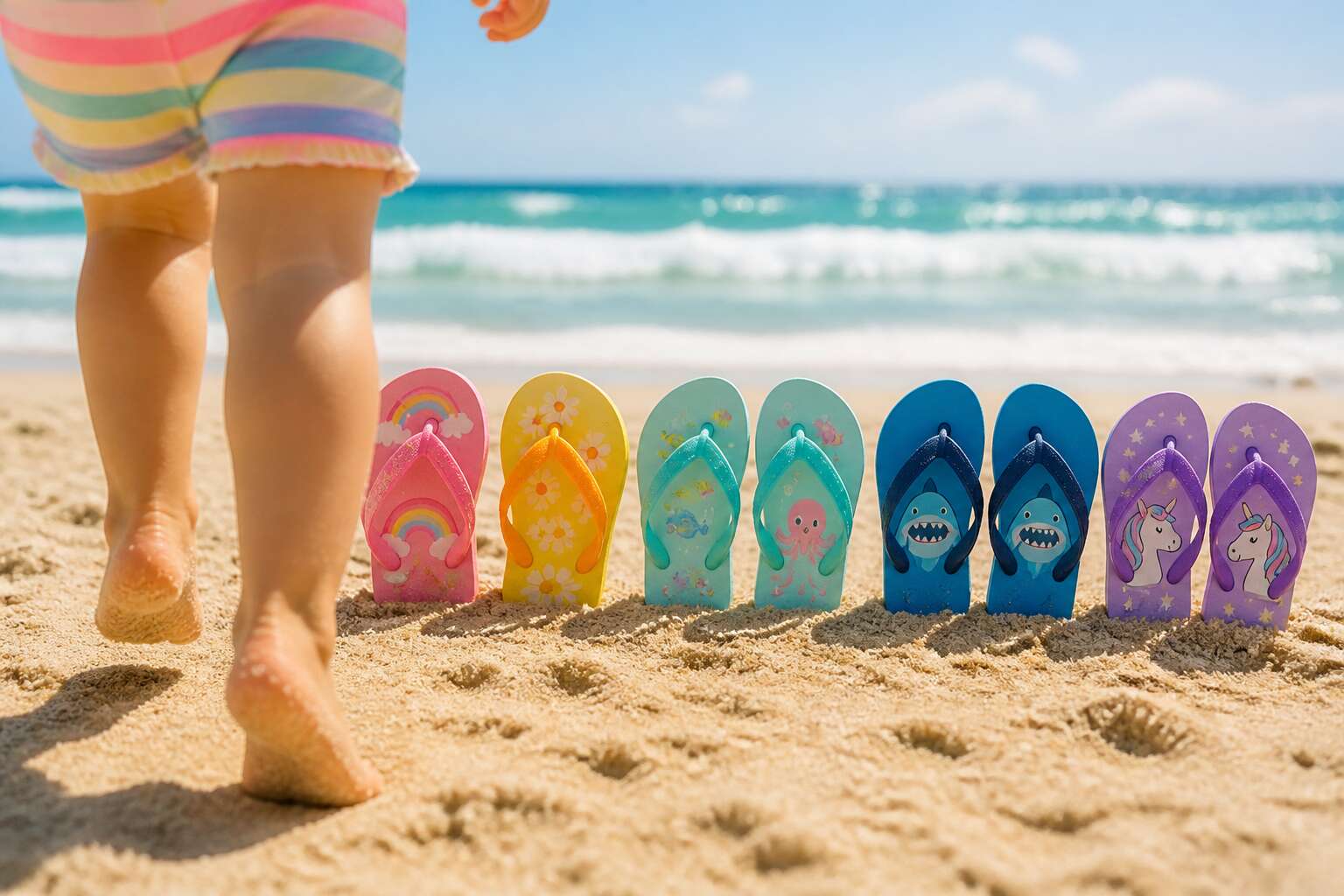
Bright colors and playful patterns dominate season’s warm-weather sandals. For South African parents, choosing flip flops for kids means embracing bold hues that survive playground scuffs. Neon oranges, electric blues, and sunshine yellows are everywhere! Patterns range from jungle animals to geometric zigzags. One trend stands out: color-blocked straps with contrasting soles. These designs help kids spot their sandals in piles at school. Another popular choice is tie-dye effects in pastel shades. I’ve noticed a surge in these prints:
- Marble swirl effects
- Sea creature motifs
- Checkerboard panels
Each pattern adds personality without sacrificing comfort. South Africa’s market values durability, but style drives the purchase. Bright sandals reflect sunlight, keeping feet cooler on hot pavement. Playful patterns hide minor dirt, a practical benefit for active kids. Ultimately, these trends let children express themselves while parents prioritise fit and safety. For the newest flip flops for kids, expect bolder colour mixes.
Favorite Characters and Licensed Themes
Nearly 70% of children choose sandals based on the character printed on the sole. That statistic from a local retail survey explains why licensed themes dominate flip flops for kids in South Africa. From superheroes to animated animals, these designs turn a simple sandal into a treasure.
Parents find that a familiar face encourages reluctant toddlers to keep sandals on. The characters also serve as identification markers at daycare or the beach. I have watched kids refuse to remove their flip flops because the strap features their favourite dinosaur.
- Superhero emblems and capes
- Animated movie characters
- Local wildlife mascots
These themes appear on straps, footbeds, and soles, leaving playful imprints in the sand. For older kids, subtle monogram versions offer a grown-up look. The result is a market where flip flops for kids function as both footwear and identity.
Eco-Friendly and Recycled Materials
Many parents assume recycled means boring. In South Africa, the opposite holds true. A recent survey indicated that 63% of guardians now examine the material composition before letting a child pick a pair. That shift appears directly in the sandals market.
Eco-friendly flip flops for kids often use reclaimed ocean plastic or recycled rubber from tyre waste. Some brands incorporate plant-based dyes sourced from local fynbos. These options maintain vivid colours without the chemical footprint.
- Footbeds moulded from compressed sugarcane fibre
- Straps woven from recycled PET bottles
- Soles reinforced with natural cork dust
The result is a category where environmental responsibility meets beach-ready style.
Light-Up Soles and Novelty Details
If your child’s sandals do not flash, blink or glow, are they even summer-ready? Light-up soles have become the defining trend in warm-weather footwear. Every step on a Durban pavement triggers a burst of colour, and children cannot get enough.
Not all light-up technology performs equally, though. Sealed LED units are essential. Cheap versions die after the first puddle. The better options keep flashing for months, surviving sand and regular beach use.
Several novelty details are gaining traction:
- Spinner charms attached to the toe post
- Holographic straps that shift hue in direct sun
- Built-in whistles for emergency attention
- Glow-in-the-dark outsoles charged by daylight
When choosing flip flops for kids, remember that novelty features do not replace fit or grip. They simply make the walk back from the beach more entertaining.
Caring for and Extending the Life of Children’s Sandals
Cleaning and Drying Best Practices
South African summers are hard on footwear. One season of playground sand, pool chlorine, and dusty streets can leave flip flops for kids looking worn in weeks. Most damage comes from neglect, not wear.
Clinging sand is the main cause. It grinds into the sole and strap anchors, wearing down the foam from inside. A quick rinse after beach trips helps. Dry them in the shade. Direct sun bakes the EVA and makes it brittle.
A simple cleaning routine prevents most of this.
- Rinse off loose sand and grit before washing.
- Wipe straps and footbed with warm soapy water.
- Use a soft-bristled brush for stubborn marks.
- Rinse thoroughly so residue does not attract new dirt.
Drying matters just as much. Shake off excess water, then place the sandals upright in a well-ventilated area. Stuffing the toe with newspaper absorbs moisture overnight. Never use a tumble dryer. For any pair of flip flops for kids, this routine prevents premature cracking and warping.
Knowing When to Replace Outgrown Pairs
Even with a solid cleaning routine, flip flops for kids last longer when they are not worn every single day. Rotating between two pairs gives the foam time to regain its shape. Store them flat, not piled under other shoes, to prevent the straps from bending out of alignment. Check the strap anchors regularly. A small tear near the anchor point can be fixed with strong glue before it becomes a full break.
Outgrown pairs are dangerous long before they become uncomfortable. Look for a toe that hangs over the front edge or a heel that reaches the back rim. The sole loses its non-slip grip when the tread wears smooth. A strap that keeps slipping off while walking is another clear signal. For safety and comfort, replace any flip flops for kids that show these signs.
Storage Tips for the Off-Season
When the last of the autumn heat fades, it is time to retire the summer’s footwear. A quiet drawer holds its pair of flip flops for kids, but careless packing can ruin their shape. South Africa’s humid coastal winters encourage mildew, so storage demands dry air and loose fit.
Before tucking each pair away, release the tension on the straps by folding them inside the sole. This prevents creases from setting into the rubber. Then place the sandals in a breathable cotton bag, never a sealed plastic container.
- Keep the sandals upright, not stacked, to protect the arch.
- Add a silica gel sachet to absorb moisture.
- Check twice a month for any signs of mould.
Rotating the stored pairs with the current season’s footwear keeps the material supple. When the next summer returns, those flip flops for kids will feel ready for the first beach day.
Quick Fixes for Strap and Sole Damage
The true test of any summer sandal is not the first sunny day, but the third. Children treat their footwear with the same regard they give to a dropped ice cream, and the straps bear the brunt of this neglect. When a thong snaps on a pair of flip flops for kids, many parents reach for the bin. A better instinct is to reach for a needle and waxed thread, which can resurrect a broken anchor point in minutes.
For sole separation, a dab of strong adhesive applied with a toothpick works wonders, provided you clamp the layers while it cures. I have also seen a clever trick: a small patch of bicycle inner tube glued over a worn heel prevents a total blowout. These small acts of maintenance extend the life of these sandals, ensuring they are outgrown rather than unworn.
Matching Sandals With Summer Outfits
A snapped strap gets attention, but grit does the hidden damage. Wipe down the soles after a beach day. Salt and sand grind into the footbed. Kettle steam will reshape a sagging sole in minutes. These habits keep flip flops for kids wearable through a second season.
Matching sandals with summer outfits needs restraint. Neutral straps work with any pattern.
- White straps suit floral dresses.
- Tan goes under denim.
- Neon pairs fit water parks.
Let the sandal sit quietly beneath the outfit. A child who is comfortable moves more freely.

0 Comments