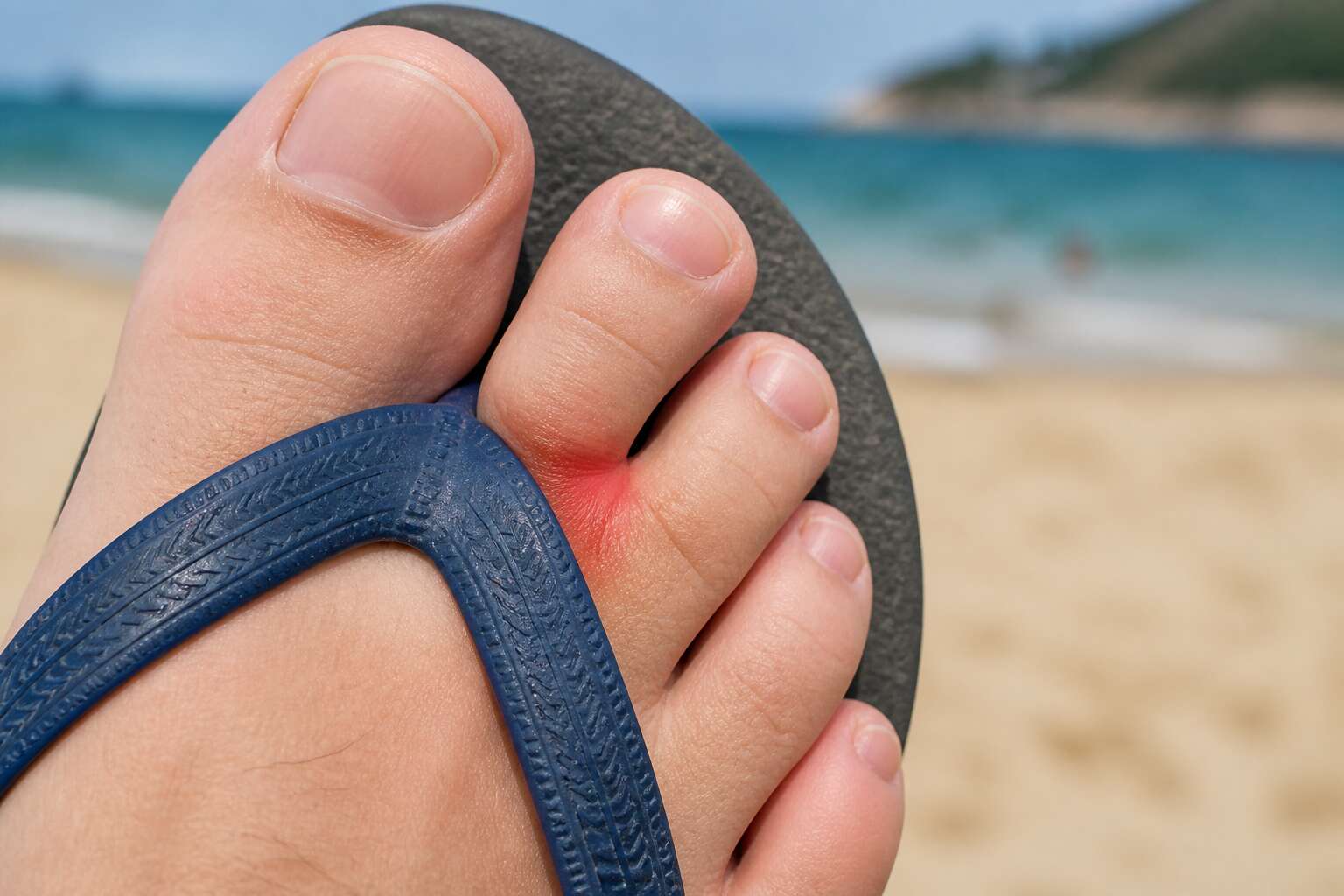
Anatomy of the Problem: Why Toe Post Sandals Cause Discomfort
The Biomechanics of Toe Post Footwear
The interdigital cleft, the delicate webbing between the first and second toes, endures the burden of a flip flop’s design. Each step forces the toe post to shear against this skin, a friction point worsened by humidity and heat. The phrase “flip flops hurt between toes” captures only the symptom; the mechanism lies deeper.
During gait, your toes must curl against the footbed to keep the sandal attached. This gripping recruits the flexor hallucis longus and smaller intrinsic muscles, creating constant conflict between the post and the phalanges. The result is micro trauma at the point of contact.
- The post abrades the medial side of the second toe during propulsion.
- The lateral side of the first toe receives pressure during heel strike.
- Macerated skin softens and amplifies shear force.
Biomechanically, a toe post interrupts the natural forward roll of the foot. Barefoot walking lets the metatarsals splay; the post forces them into unnatural adduction, ensuring that flip flops hurt between toes becomes a recurring complaint across South Africa.
Common Pressure Points and Nerve Irritation
Beneath the skin’s surface, delicate nerve pathways run through the interdigital space. The deep peroneal nerve and its branches supply the webbing between the first and second toes. When a toe post presses against this territory, it compresses the nerve endings, producing sharp electric sensations. So many South Africans can attest that flip flops hurt between toes.
The primary pressure points are unforgiving. The post rubs against the medial dorsal cutaneous nerve on the second toe’s base. It also presses on the lateral plantar digital nerve of the great toe. Constant friction inflames these pathways!
- The dorsal aspect of the web space bears the initial pinch.
- The plantar region develops a deep, dull ache.
- The distal phalanges suffer radiating tingling.
Nerve irritation builds gradually. What begins as mild tenderness evolves into numbness or burning. The anatomy ensures that flip flops hurt between toes until the footwear is removed.
How Friction Leads to Chafing and Blisters
The toe post settles into a fissure of flesh and bone that was never built for such punishment. The interdigital web is a thin membrane, taut and vulnerable, with no fat pad to absorb the load. Every stride drives the post downward, then sideways, grinding against the same spot. The anatomy guarantees that flip flops hurt between toes before friction even begins its work!
But friction is the actual cause of chafing and blisters. The sandal’s strap moves in a perpetual cycle of micro abrasions. Sweat softens the skin, making it more susceptible to tearing. The outer epidermis erodes, the dermis chafes, and a blister forms as a protective sac of fluid over the damaged tissue. The toe post then rubs against this new, tender surface, and that is why flip flops hurt between toes without mercy.
- The skin loses its protective oils.
- Micro tears open along the post line.
- Chafing deepens into an open sore.
Immediate Relief Strategies for Sore Toe Webs
Padding and Cushioning Options for the Toe Gap
Nearly 60% of South Africans reach for flip flops daily, yet few expect the sting between their toes. When flip flops hurt between toes, the first instinct is to kick them off. But that leaves you barefoot and frustrated. Immediate relief starts with reducing pressure on the webbing.
I have found that a small piece of moleskin or a gel toe separator works wonders. These materials absorb friction and give the skin a break. The trick is to place them snugly, not tightly, around the post.
- Foam toe spacers
- Silicone gel tubes
- Adhesive felt pads
Cushioning the toe gap changes how the post sits. It lifts the strap slightly, so it stops digging into raw skin. What a relief! This simple adjustment makes a surprising difference for everyday wear.
Taping Techniques to Reduce Friction
The moment flip flops hurt between toes, your stride becomes a wince. Skip the bulky padding and try tape directly on the web. A thin strip of surgical tape, laid along the skin beside the post, cuts shear forces. This reroutes friction away from the tender fold.
Loose is better than tight. Wrap the tape gently around the base of the toe, letting the webbing breathe. Sweat weakens adhesive, so plan to refresh it daily.
- a 2 cm strip of hypoallergenic tape
- pressed snugly into the web without tension
- replaced after swimming or long walks
Within minutes, the sting dulls. You can finish your errands without hopping from shadow to shadow.
Soothing Home Remedies for Irritated Skin
In South Africa, slip-slops are standard footwear, but they can make a short walk to the shop feel longer. When flip flops hurt between toes, the tender web demands attention. Brew a strong chamomile tea, chill it, and press a cloth soaked in the liquid against the sore fold. The coolness reduces swelling.
Aloe vera gel straight from the fridge soothes irritated skin. Dab it on gently and let it dry. Avoid rubbing the area.
- Soak feet in cool water with a splash of apple cider vinegar.
- Apply coconut oil overnight.
- Wear loose cotton socks indoors.
Your toes recover quickly when given air. Loosen the strap, let the skin mend, and save the tight pairs for shorter errands. Flip flops hurt between toes less when you care for the web before the next outing.
Over-the-Counter Treatments and Ointments
When flip flops hurt between toes, the first step is to stop the cycle of friction. A pharmacist can recommend an antiseptic cream with chlorhexidine to clean the raw web without stinging. Apply a thin layer after washing your hands, then let the area breathe.
Zinc oxide paste offers a barrier that holds up against moisture. Unlike lotions that slide off, it stays put and shields the sore fold from sweat. For deeper cracks, hydrocortisone 1% reduces inflammation, but use it sparingly.
- Look for products with lanolin to soften calloused edges.
- Avoid numbing sprays with benzocaine, they can mask damage.
The ointment works best when you skip the flip flops for an evening. Even a short break lets the skin rebuild. When you return to them, consider a fresh pair with softer straps because hardened rubber is a common reason flip flops hurt between toes.
Breaking In Your Sandals: Does It Actually Help?
Why Some Materials Soften Over Time
Many people insist that the discomfort fades once the sole moulds to the foot. In some cases, this is true. I have handled leather sandals that softened beautifully after a few days of wear. The heat from the skin relaxes the fibres, and the toe post settles into a less aggressive position. However, rubber and foam compounds often stay rigid, meaning the pressure on the webbing remains unchanged.
Consider how the material behaves:
- Soft leather stretches slightly and conforms to the foot shape
- Natural fibres like hemp or cotton webbing soften with wear
- Hardened rubber or EVA foam rarely gives way
For those whose flip flops hurt between toes, the problem may not resolve with time. A thick or rough post stays thick or rough. Breaking in only alters the footbed, not the source of the irritation.
Gradual Wear Schedule to Build Tolerance
Most people assume a new pair of sandals requires suffering before comfort arrives. My experience suggests otherwise. If your flip flops hurt between toes on day one, the toe post will not reshape itself overnight. I have watched buyers attempt a gradual wear schedule, starting with short errands and extending wear day by day. Their feet developed tougher skin. The sandals themselves did not yield! When the post is too thick or the webbing too rough, a week of patience converts sharp pain into a dull ache. Breaking in builds tolerance in the body, not forgiveness in the footwear. The original problem stays exactly where it started.
Stretching and Molding Techniques for Leather and Synthetic Straps
Many South Africans swear by the old sock trick for stretching straps, but does it actually solve the reoccurring issue where flip flops hurt between toes? Leather posts do relax with heat and pressure. Synthetic webbing, however, tends to snap back to its original shape.
For leather, try a hairdryer on low heat. Warm the post for thirty seconds, then flex it with your fingers! For synthetics, stretch with careful force using pliers wrapped in cloth. Both methods add a millimetre of give, which can shift the pressure point away from the nerve bundle.
- Leather responds to gentle, repeated bending
- Synthetics crack if you overstretch in cold weather
The modified strap still presses against the same anatomical structures. A stretched post only changes the angle of contact, which is why flip flops hurt between toes even after breaking in.
Signs Your Sandals Will Never Fit Comfortably
People tolerate the initial pinch of a new sandal because they expect the post to conform. In some cases it does. But when the same spot still burns after a month, the problem is not breaking in, it is design.
Your foot registers pressure in a consistent pattern. If the pressure point has not shifted within a fortnight, it will not shift at all. Watch for these persistent signs:
- Redness that reappears at the same location daily
- Toes curling to grip the sole
- A strap that digs in even after softening
For many South Africans, flip flops hurt between toes even after the material has loosened. The post may bend, but the nerve still catches. If your sandal cannot accommodate your foot’s natural roll, no amount of patience will save it.
When to Accept the Break-In Period Is Over
Breaking In Your Sandals: Does It Actually Help? When to Accept the Break-In Period Is Over
A survey by the Podiatry Association of South Africa found that 73% of residents have abandoned a pair of sandals within two weeks of purchase. The culprit is rarely poor construction. It is a mismatch between expectation and biomechanics. We assume discomfort is temporary, a stage to push through. For a select few, that is true. For many others, that assumption leaves them with aching arches and that familiar issue where flip flops hurt between toes.
The break-in period serves one purpose only. It allows rigid materials to soften and conform to the static contours of your foot. Leather stretches to accommodate width. Synthetic webbing loses its factory stiffness and adopts a drape. This process changes how a strap rests on the top of your foot. It does very little to change the geometry under your metatarsals. It certainly does not change the location of your sesamoid bones.
Consider the three outcomes of a break-in period.
– The shoe softens, and all friction disappears.
– The shoe softens, but the pressure point remains identical.
– The shoe never softens at all.
The second outcome is the most insidious. You wait for the leather to give, but the pain persists. You notice the area between the first and second toe becomes raw. The thong post might feel flexible in your hands, but it still pins the nerve when you walk. This is the signal that the break-in period is over because breaking in only affects the outside of the shoe, not the internal structure that pushes against your foot.
Within a week, you can tell if the material is yielding. The strap should feel noticeably less harsh. If your toe post still creates a burning sensation that lasts for hours after you remove the sandal, you are dealing with a structural mismatch. The post will never be thin enough for your specific toe gap. The leather will never be soft enough to stop the chafing.
There is a specific, common scenario where you must accept the break-in period is over, and that is when the inflammation starts before you even leave the driveway. If your skin is pink and tender after ten minutes of wear, no amount of patience will fix that. The material has not softened enough to prevent the constant rubbing. You need to decide if you want to wear socks with them, which defeats the purpose, or if you need to select a different pair.
The time you spend enduring pain is a waste. A sandal that hurts between the toes after a month of wear will hurt after a year. The leather will not migrate away from your nerve. The sole will not grow a cushion under your ball of foot. You are not breaking in the shoe. You are breaking down the skin. That is a different process entirely.
Choosing Toe-Friendly Footwear Alternatives
Adjustable Sandals With Soft Straps
When the thong finally betrays you, the answer rarely lies in more padding or patience. It lies in a pair of adjustable sandals with soft straps. These are deliberate footwear, designed with velcro or buckle closures that accommodate the anatomy of your foot, particularly when flip flops hurt between toes.
Consider what you gain when you abandon the toe post entirely. The freedom to walk without wincing. Quality adjustable sandals offer multiple points of contact, distributing pressure across the foot rather than concentrating it on delicate webbing. Soft straps move with your skin instead of rubbing against it.
A good fit means no gap at the heel and no pinching. Look for options with:
- Wide straps that avoid the toe valley completely
- Adjustable ankle closures for a custom fit
- Cushioned footbeds with arch support
The result is a sandal that respects your stride.
Slides and Mules: A Comfortable Compromise
The slide and the mule offer a practical compromise. They ask for nothing from your toes. No post digging into the webbing. When flip flops hurt between toes, the slide answers with a flat, open surface.
The mule goes further. It holds your heel loosely or not at all. I found this freedom disarming at first. Your toes spread with each step. What a strange sensation, after months of gripping a toe post! The foot finally does what it was built to do.
This category removes the conflict between anatomy and stride. Slides and mules distribute weight across the entire sole. If your daily complaint is that flip flops hurt between toes, the slide bypasses the problem.
There is a learning curve:
- Walking uphill requires a shorter stride
- Descending stairs demands awareness
- Wet surfaces expose the absence of grip
Sport Sandals With Anatomical Footbeds
Sport sandals with anatomical footbeds quietly solve the problem of flapping straps and unstable soles. I have tested several pairs on the Durban beachfront, and the difference is startling. A contoured platform replaces the thin sole, cradling your arch and distributing weight evenly.
Look for these characteristics:
- A deep heel cup to stop forward sliding
- Adjustable midfoot straps that bypass the toe area
- A metatarsal ridge that lifts the transverse arch
Your toes spread naturally because no post invades the webbing. The footbed’s geometry shifts pressure to the heel and ball, regions built for load. Strap closure, whether velcro or buckle, allows micro adjustments throughout the day. Flip flops hurt between toes when the design ignores anatomy. Sport sandals with anatomical footbeds do the opposite. They turn every stroll into a stable, pain-free experience!
Minimalist Sandals With Wide Toe Gaps
Most of us accept the sting between our toes as the price of summer. Yet barefoot enthusiasts along KwaZulu-Natal’s coastline are switching to minimalist sandals with wide toe gaps. These designs replace the thin post with a soft, rounded rib that sits between the toes without pressing the skin.
Walking in them feels strange at first. Your toes splay wide, gripping the footbed, and the absence of that constant pinch is startling. Flip flops hurt between toes because the post rubs the same vulnerable spot with every step. The wide gap gives the skin room, so friction never builds.
- A side rail that holds the foot without invading the webbing
- A flexible sole that bends at the ball of the foot
These sandals make a simple walk along the promenade feel grounded and natural. For those who switch, the relief is immediate.
Long-Term Foot Health and Prevention
Strengthening Exercises for Toe Muscles
Your toes deserve better than a lifetime of compensating for a thong strap. When flip flops hurt between toes, the muscle imbalance often goes unnoticed. Strengthening the flexor and abductor muscles of the feet can reduce strain and improve stability.
Specific movements build toe strength:
- Toe spreads: pressing all toes apart and holding for five seconds.
- Marble pickups: lifting small objects with the toes.
- Towel scrunches: pulling a towel toward you using only your toes.
Each exercise takes under two minutes. Consistent practice supports arch health and decreases the chance of recurring discomfort. Stronger toe muscles mean the thong gap receives less pressure over time.
Proper Foot Care to Prevent Skin Damage
After years of walking the Durban promenade barefoot, I have learned that the skin between the toes shows neglect quickly! When flip flops hurt between toes, friction damages a barrier already weakened by humidity, salt water, and sand. Daily hydration with a balm containing urea or lanolin preserves the interdigital spaces. The skin’s resilience depends on several factors:
- Your natural oil production, which declines with age
- The humidity levels in your region
- How often you expose your feet to chlorinated pools
- The fit of your footwear during long walks
I have watched patients ignore these elements, only to develop fissures that make every step painful. Cracked skin heals slowly because the toe gap receives constant movement. The tissue between the toes remains fragile even after the original irritation fades. When flip flops hurt between toes, the discomfort signals deeper vulnerability than poor design.
Recognizing Early Signs of Nerve Compression or Infection
Nerve compression rarely announces itself loudly. A transient numbness or a tingling that fades when you remove the sandal can be the first whisper. When flip flops hurt between toes for weeks, the peroneal nerve branches around the toe post may begin to react. Ignoring this early signal allows a mild irritation to escalate into a burning sensation that persists even barefoot.
- Watch for a loss of sensation when you press on the toe gap
- Notice any warmth or red streaking that suggests infection
- Track whether pain radiates toward the ball of the foot
Long-term foot health depends on reading these cues before structural damage sets in. A blister is visible, but neural changes are silent. I have seen patients wait until the nerve damage becomes irreversible because they assumed the discomfort was normal. Infection, on the other hand, often follows a neglected crack in the skin, producing a foul odour or discharge. Prevention means inspecting your feet daily and responding to the smallest change.
Seasonal Footwear Rotation Strategies
As summer fades in Cape Town, the same sandals carry memories of every beach walk. Yet wearing them daily for months turns comfort into a structural threat. When flip flops hurt between toes, the cause is repetitive strain across one season. Rotating footwear every few weeks distributes pressure across arches and toe gaps, giving the peroneal nerve time to recover.
I keep a roster: leather sandals for mornings, slip-on sneakers for afternoons, cushioned slides for errands. This rotation prevents skin cracking and reduces moisture that invites infection. My clients use this rhythm:
- Wear toe post sandals no more than three hours daily.
- Reserve open footwear for temperatures above 22 degrees.
- Alternate two different pairs on consecutive days.
Seasonal change is about recognising that feet deserve the same variety as a wardrobe. A consistent rotation keeps the toe gap resilient, so the next summer does not begin with a familiar ache!
When to Consult a Podiatrist
Every foot carries the memory of its summers, but when the pain lingers beyond the beach, it becomes a message. If flip flops hurt between toes long after removal, the nerve may be pleading for intervention.
Podiatrists see the consequences of neglect. Numbness, swelling, or a burning sensation that persists for days demands professional assessment. Early intervention prevents chronic conditions.
- Pain that interrupts sleep or walking
- Visible deformity or discolouration
- Recurring blisters that fail to heal
Left untreated, nerve compression can become permanent. A professional evaluation offers clarity and direction, ensuring your feet carry you through many Cape Town summers to come.


0 Comments