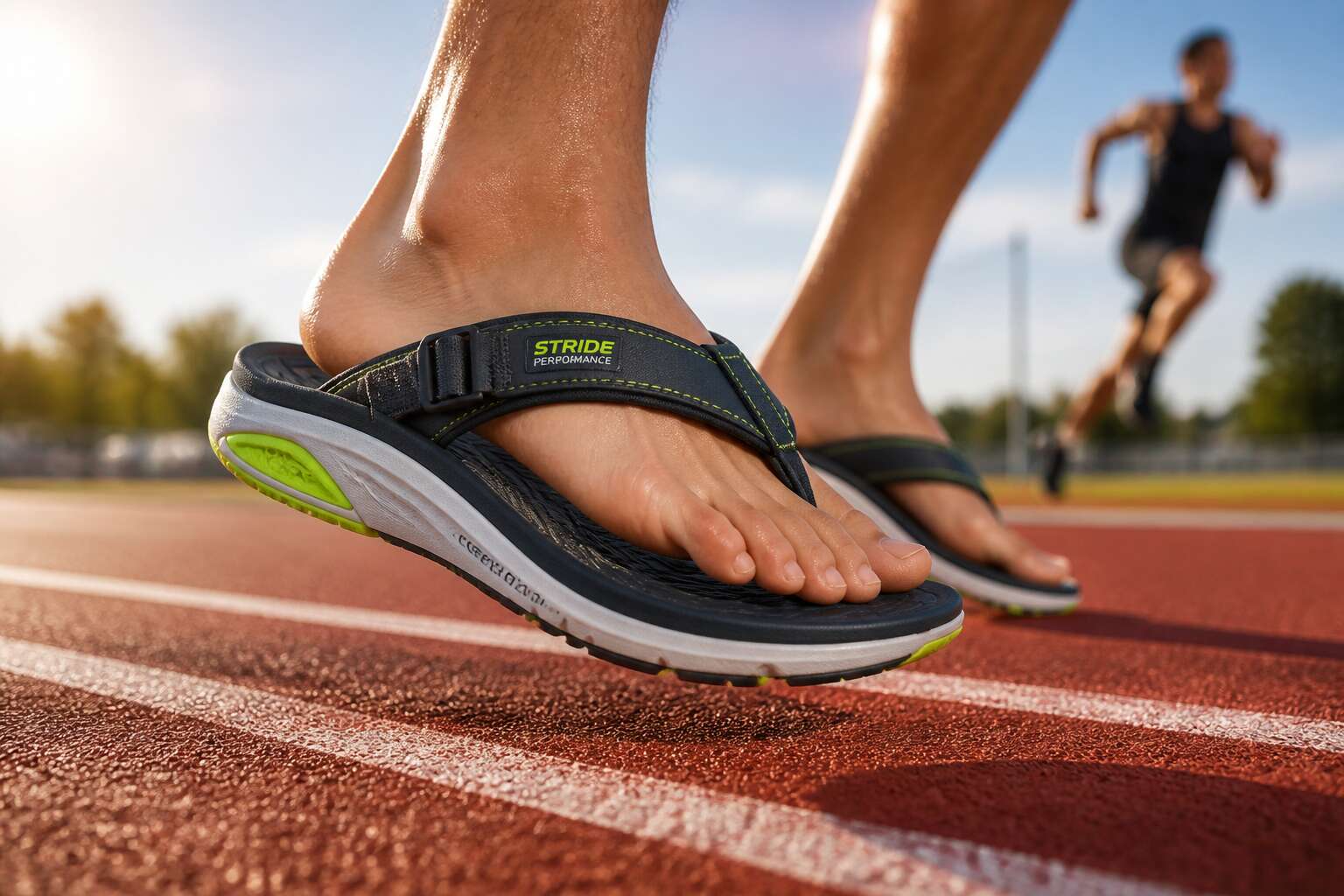
The Rise of Performance Flip Flops
From Beachwear to Athletic Gear
Flip flops carried a straightforward leisure duty. The simple beach sandal felt flexible and light. Athletic wear became a territory for long trail routes. The rise of a durable slide uses stiff rail geometry in a compact form. The run first flip flops now occupies a controlling spot in the South African market.
Instead of collapsing under the weight alteration, the base holds firm. This change moves the pair past a casual foot seat. Here are the common upgraded segments:
- Higher shore rubber with a stable wet grip.
- An arch mould that manages the foot’s centre.
As a runner in Durban, I see this shift fully active in the morning run. These pairs support the calves without losing control or adding breakage.
Why Runners Are Switching to Sandals
The sun bakes the pavement outside Durban, and the air smells of salt and hot tar. For years, our training footwear was a study in heavy cushioning, a fortress built for impact. We chased the softest landing, yet our feet grew weak, accustomed to being cradled. The shift away from that bulky protection reveals a raw truth: our soles were crying out for direct contact with the ground. This is where the run first flip flops concept enters the conversation, not as a casual afterthought, but as a serious tool for the modern runner.
The engineering behind this footwear is deceptively simple. It strips away the excess and leaves a platform that encourages a natural, forefoot strike. When you land, the thin profile transmits feedback with absolute clarity, forcing your lower legs to act as natural shock absorbers. The result is a profound strengthening of the foot’s intrinsic muscles, the ones that stabilise your arch and protect your ankles. This approach transitions a pair from a mere beach necessity to a legitimate piece of recovery equipment, a stark contrast to the passive support of traditional trainers.
For the athlete logging early morning kilometres on the promenade, the benefits become tangible quickly. The design utilises a higher shore rubber compound that resists compression, ensuring the midsole doesn’t flatten into a useless pancake after a few hundred kilometres. The sole features an aggressive tread pattern that bites into slick surfaces, offering a stable wet grip that keeps you upright during a sudden summer downpour. Beyond the sole, the frame includes an anatomical arch mould that cradles the navicular bone, actively managing the foot’s centre to prevent overpronation during those longer distances.
I have personally watched the local running club adopt this style, and the change in their form is noticeable. The calves engage earlier, and the stride shortens, reducing the jarring impact on the knees. This isn’t about abandoning support entirely; it is about a calculated rebellion against the cushioning arms race. Key elements of this design include:
- A proprietary rubber blend that increases durability without adding excessive weight.
- A contoured footbed that aligns the heel and forefoot for optimal posture.
- Straps engineered to eliminate the friction that leads to blisters, even when wet.
It is a strange irony that we spent decades building shoes thicker to solve pain, only to find the solution lies in going thinner and smarter. The run first flip flops represent a return to the fundamentals of gait, offering a sensory-rich experience that rigid shoes simply cannot replicate. They force a conversation between your foot and the road, and in that dialogue, we find the strength we nearly lost. The journey back to natural movement is not always comfortable, but the adaptive response of the human body is a remarkable thing to witness.
Understanding the Hybrid Footwear Trend
“The foot wants to feel the ground,” says Cape Town podiatrist Dr. Anke Nel. That sensation drives the rise of performance flip flops, a hybrid footwear trend now visible from the promenade to the trailhead. These are run first flip flops, engineered for motion, not lounging. The design strips away excess cushioning and restores sensory feedback to every step.
The footbed offers arch support without rigid structure. The strap locks the heel without squeezing. The rubber compound grips wet tiles during a summer downpour. This hybrid transitions from post-race recovery to morning kilometres.
- Zero drop platform encourages calf engagement
- Hexagonal tread prevents slip on slick surfaces
- Contoured footbed supports the metatarsal arch
Adopting run first flip flops signals a move toward minimal interference with natural gait.
Key Features to Look For
Arch Support and Cushioning
Most flip flops treat arch support like a suggestion. Run first flip flops change that calculus. Your foot needs a contoured bed that follows the medial longitudinal arch, not a flat slab. Look for a pronounced yet forgiving ridge under the midfoot. Cushioning should manage impact without sacrificing ground feel. A 20 mm stack height works for most runners; anything thicker risks instability on uneven trails.
Check these details before you commit:
- A heel cup that holds your foot in place, not a vague dip.
- A toe post that doesn’t dig into the webbing.
- A midsole with rebound, not just compression.
The foam compound matters. Ethylene vinyl acetate feels dead after 100 kilometers. Polyurethane retains bounce longer but adds weight. Run first flip flops with dual density midsoles deliver the right mix. That combination reduces strain during long runs.
Traction and Outsole Design
Somewhere on Table Mountain, a tourist is sliding toward a kloof in slippery flip flops. That scene repeats on every slick granite shelf after rain. Run first flip flops have to carry rubber that grips, not a smooth slab that slides.
- A sticky rubber compound that holds traction on wet rock and dry slab alike.
- Directional lugs that push water and mud away from the foot.
- Siping across the contact patch so the sole flexes with uneven ground.
Descending Lion’s Head demands a heel brake section. Your foot slides forward in a flimsy sandal; a shaped heel pocket and trailing rubber lip stop that motion. The toe bumper takes rock strikes, so it needs a real edge. A sole that flexes mid-arch wastes energy; bend it near the ball of the foot instead. These sandals turn sketchy descents into steady ground.
Strap Materials and Adjustability
Weight and Flexibility
Snug straps and grippy outsoles mean little if the platform itself weighs you down. Run first flip flops with heavy midsoles force your calves to work overtime, turning a smooth stride into a plodding shuffle. Conversely, a featherlight construction lets your legs stay fresh across long distances.
Flexibility requires careful engineering. The material must flex through the forefoot during push off, yet remain stable under your arch. Overly pliable soles lack structure; overly stiff ones create hot spots. Look for a balance that mimics a barefoot feel with enough support for hard pavement.
Durability and Water Resistance
Durability in run first flip flops comes down to how the outsole bonds to the midsole. Inexpensive sandals start separating within months. Quality pairs use fused construction that survives repetitive bending and stops water from forcing its way between layers. The footbed matters too. Closed cell foam resists absorbing moisture, which prevents both odour and premature breakdown.
Water resistance also affects strap integrity. Synthetic webbing handles repeated soakings far better than leather or canvas. Quick drying materials mean you can hit a puddle and keep moving without chafing. And while rubber compounds vary, a good pair holds grip even on wet paving. I’ve tested this on rainy Johannesburg mornings, and the difference is obvious.
How to Choose the Right Pair
Assessing Your Foot Type
Matching Your Running Terrain
According to the 2024 State of the Trail Running report, nearly 60% of South African runners now incorporate some form of minimalist footwear into their weekly mileage. When you transition to run first flip flops, the terrain beneath your feet becomes the primary determinant of selection, not just aesthetics. For the rocky, uneven granite of Table Mountain or the loose scree of the Drakensberg, you require a model with a pronounced toe spring and a dense, rigid outsole that can dissipate impact from sharp edges. A flexible sole is a liability on this terrain.
Conversely, long stretches of unforgiving urban pavement demand a different approach. Here, the emphasis shifts to midsole shock absorption and a strap system that prevents micro-abrasions from repetitive friction. The specific demands of your locale narrow your choices considerably:
- Pavement and hard-packed jeep track: Prioritize models with a thicker heel cradle and moderate flex.
- Rocky scrambles and technical trails: Seek out aggressive tread lugs and a reinforced shank.
- Wet or muddy conditions: Choose a compound that offers bite, as water-slicked surfaces nullify standard rubber.
A sandal engineered for the slick mud of the Cape Flats will feel clunky on a fast, dry road session. The subtle interplay between ground contact and your gait cycle means that a shoe providing blissful freedom on the promenade can become a hazard on a gravel path cluttered with loose stones. Ultimately, the correct pairing is a negotiation between your biomechanics and the specific mineral composition of your route. The best run first flip flops for you are the ones that disappear beneath you, regardless of the surface.
Sizing and Fit Guidelines
For run first flip flops, the size chart is often misleading. I have seen runners choose their usual shoe size, then deal with a heel that overhangs the sole. A proper fit leaves a thumbnail’s width ahead of your longest toe, because feet swell during a run. That gap is non negotiable.
The midfoot cradle should be snug. If a finger slides between strap and instep, the fit is loose. If the strap leaves a mark after ten minutes, size up!
Consider these checks:
- Wear the socks you plan to run in.
- Walk on an incline to spot heel slip.
- Bend the sole; it should flex at the ball of your foot.
Each brand’s last differs. A size 9 in one model may clamp your metatarsals in another. Always buy for the larger foot. Run first flip flops should vanish from awareness, not pinch with every stride.
Trying Before Buying
So you’ve decided to ditch the clunky trainers and embrace the breeze. Smart move. But picking the right pair of run first flip flops is a decision that can go very right or very wrong. It is not about grabbing the cheapest pair at the counter. It is about finding a match for your specific gait and foot shape.
When you finally get a pair in your hands, the real work begins. Do not just look at them. Handle them. Twist the sole. If it feels like a rigid plank of wood, put it down. A proper running sandal needs to flex with the natural bend of your foot. You want torsion, not timber.
Next, you need to feel the ground through them. Run first flip flops are supposed to offer protection, but they should not numb you to the trail. If the footbed is so thick that you cannot sense if you are stepping on a pebble or a puddle, you lose a key safety feature. You want a balance between cushioning and ground feedback.
Now, the straps. This is where most people fail. Ignore the colour and focus on the closure. Does the system allow for micro-adjustments? A strap that only has two holes is a limitation. You need to dial in the tension so it holds your heel securely without strangling your instep. If you have to curl your toes to keep the sandal on, that is a clear sign the fit is wrong. That grip will cause cramps and fatigue within a few kilometres.
Here are a few physical tests to perform before you commit:
– Check the heel strike: The back of the sandal should align with your heel bone, not sit off to the side.
– Inspect the toe-off: Your toes should not hang off the front edge, but they also should not feel cramped.
– Verify the arch: The sandal’s contour should support, not poke, the arch of your foot.
– Simulate a wet slide: If your foot moves laterally when you walk on a smooth floor, the grip is insufficient.
Finally, consider the terrain you will cover. South African conditions can be harsh. If your route involves loose gravel or slick river stones, you need a sole with aggressive lugs. A flat, smooth sole might be fine for a pavement dash, but it becomes a hazard off-road. The lugs are what provide the bite to keep you upright when you transition from tar to trail.
Once you have found a pair that passes these tests, remember that they will soften. A sandal that feels snug in the shop might feel too loose after twenty runs. Look for a model that allows you to tighten the straps further as the materials break in. This longevity of adjustment is often the difference between a sandal that lasts for years and one that ends up in the back of the cupboard. Take your time. Your feet will thank you during that next long Saturday morning run.
Breaking In and Training With Sport Sandals
Gradual Acclimation Schedule
Your feet will protest when you first wear run first flip flops for running. That protest is normal, not failure. A gradual acclimation schedule solves it.
Follow this week by week plan:
- Days 1 to 2: Walk indoors for ten minutes. No running.
- Days 3 to 4: Walk outside for twenty minutes. Keep your pace casual.
- Days 5 to 7: Alternate two minutes of jogging with three minutes of walking. Total time fifteen minutes.
- Week 2: Jog for five minute blocks with two minute recoveries.
Chafing or redness appears when you rush the process. The straps need time to soften against your skin. Most runners manage thirty steady minutes by week three. Sport sandals respond to patience, not force.
Strengthening Foot Muscles
Your feet are not weak. They are underused. When you first lace into run first flip flops, every stride strips away the artificial support your regular shoes provide. The intrinsic muscles, the ones you forgot existed, suddenly carry the load.
This break-in period is a strength session disguised as a run. Your toes grip, your arches flex, and your calves fire in unfamiliar patterns. Most runners feel a deep fatigue by day five. That is not a warning sign. It is adaptation.
- Toe splaying, which teaches your foot to spread wide
- Heel raises, which build calf and arch stability
- Short foot contractions, which pull the ball toward the heel
Sport sandals force your feet to work like they did before shoes. The result is stronger arches and better proprioception. Do not rush this process. Your feet are rebuilding from the ground up.
Combining With Traditional Running Shoes
Most runners abandon their regular shoes too quickly when they make the switch. That is a mistake. The smartest transition into run first flip flops is a deliberate rotation between footwear types.
Traditional trainers handled longer efforts or wet mornings. The sandals covered easy runs and short technical sessions. This does not dilute the adaptation. It extends it. Your feet learn to modulate between cushioning and barefoot mechanics, which builds a robust stride.
- Longer efforts stayed on trainers
- Sandal-only days appeared after day ten
- Speed work remained on traditional shoes
I have found that the combination shortens the break-in period without the sharp fatigue. The goal is not retiring your shoes. It is making the sandals a tool in a larger system.
Recovery and Post-Run Use
The first few kilometres in run first flip flops feel raw. The straps press hard, the sole flexes stiffly, and your arch aches. I wore mine around the house for a week before hitting the road. That gradual flexing softened the footbed and let the thong settle properly.
- Blisters on the inner toe signal strap friction; adjust the fit.
- Muscle soreness in the lower leg means the sandals are working.
- Heel lift disappears after the sole flexes more.
For training and recovery, these sandals excel. After a hard session, the open top lets your feet breathe, and the flat sole encourages a natural gait. Use them for short, easy walks or cool-down jogs.
Common Mistakes to Avoid
Certain blunders sabotage the entire experiment. The most common one is expecting instant comfort. The first road-test will feel awkward. You are not wearing them for a stroll; you are asking your anatomy to remember an older way of moving. Forcing a long run before the footbed learns your pressures invites more harm than good. This is when patience, not grit, becomes the wearable skill.
Another error is ignoring the developing calluses. A slight pinch becomes, after a week, a raw point. Adjust the thong placement. Modify the strap tension. Your foot will change shape as the muscles wake up. This is not a static fit; it adapts. Some runners also overdo the mileage before the sole flexes properly. Keep the pace restrained and the distance brief for the first two weeks. The foot needs to rebuild intrinsic strength, the kind lost inside padded shoes.
One anecdote illustrates the process. A trail runner complained of a regular slap. He had kept the straps too loose. The solution was simple, tightening the toe post to hold the heel firmly during the early flex phase.
Common mistakes to avoid while adapting:
– Starting with a 10 km run immediately.
– Keeping the straps too tight around the midfoot, causing cramping.
– Forgetting sunscreen on the top of the feet, a real South African concern.
– Believing blisters are a badge, they are a warning.
– Giving up after the first sore morning.
The training arc favors those who listen to the heel strike and the arch lift. The thong between the toes becomes less foreign each day. Once the foot stops fighting the design, you can run first flip flops through a dusty park or a shaded suburb trail. You will reach a state where you stop thinking about the sandals entirely. That forgetting marks the moment the gear has become part of your gait, not a stubborn companion.
Track Your Progress
The true measure of adaptation is not distance, it is silence. When the slap of rubber against gravel becomes a faint murmur, and the thong between your toes ceases to whisper, that is a progress report your body files without your consent. Tracking this evolution demands a ledger, not for miles, but for sensation.
After a week, note how the arch lifts when you shift your weight forward. After two, observe whether the heel strike has flattened. These are the benchmarks of unlearning the cushion. The arbitrary milestones of a training plan mean little when your sole is the instrument and the earth is the score.
1. Check for a uniform imprint of the footbed after each session; a clear heel mark and a defined ball mark signal proper pressure distribution.
2. Listen for a single, crisp footfall rather than a scuffing drag on the ascent.
3. Record the absence of calf soreness on the third consecutive day, not its presence on the first.
The goal is to reach a point where you run first flip flops without the conscious negotiation of each stride. When the sandals stop being an object of focus and become a superficial layer of your own anatomy, the process has completed itself. You are not faster; you are simply less interrupted.

0 Comments